
MindLenses
Professional
Memory
Remembering
facts, appointments,
instructions
Attention
Ability to
concentrate
Language
Finding words,
expressinga oneself clearly,
reading and writing
Visuospatial skills
Orientarsi,
agire efficacemente,
nello spazio
Executive
functions
Organizing, making
decisions, being
flexible
MindLenses
Professional
Memory
Remembering
facts,
appointments,
instructions
Language
Finding words,
expressing
oneself clearly,
reading and
writing
Executive
functions
Organizing,
making decisions,
being flexible
Visuospatial
skills
Being able to
orient oneself and
act effectively in
space
Attention
Ability to concentrate
Thanks to its unique combination of non-invasive neuromodulation and serious games, MindLenses activates brain plasticity and targets cognitive and executive functions for effective, long-lasting results.
A Breakthrough Approach To Cognitive Recovery
MindLenses Professional is the new digital therapy for cognitive rehabilitation and intervention.
One Tool, More Paths to Care
MindLenses Professional moves beyond the traditional disease-based model by targeting the functional origins of cognitive deficits — often shared across conditions with very different causes.
It doesn’t just treat symptoms, but modulates cognitive circuits selectively: that’s why MindLenses is a versatile solution across a range of diverse clinical contexts.
Discover Mindlenses for
stroke recovery
Discover MindLenses
for ADHD
Non-Invasive Neuromodulation to Unlock Brain Plasticity
MindLenses Professional pairs the power of non-invasive neuromodulation with cognitive training in the form of serious games to activate neuroplasticity and support the recovery of diminished or impaired functions.
Each MindLenses session begins with a non-invasive modulation of brain activity using a visuomotor protocol called prismatic adaptation —a well-established technique in neurorehabilitation, now applied for the first time to the rehabilitation of higher cognitive functions, thanks to the pioneering research work of Prof. Oliveri and his team.
This temporary state of heightened brain excitability is followed by a cognitive training session with serious games — adaptive, clinically designed exercises that strengthen attention, memory, language, executive functions and more.
Explore the Science Behind Prismatic Adaptation
More Than Games: Technology That Trains the Brain
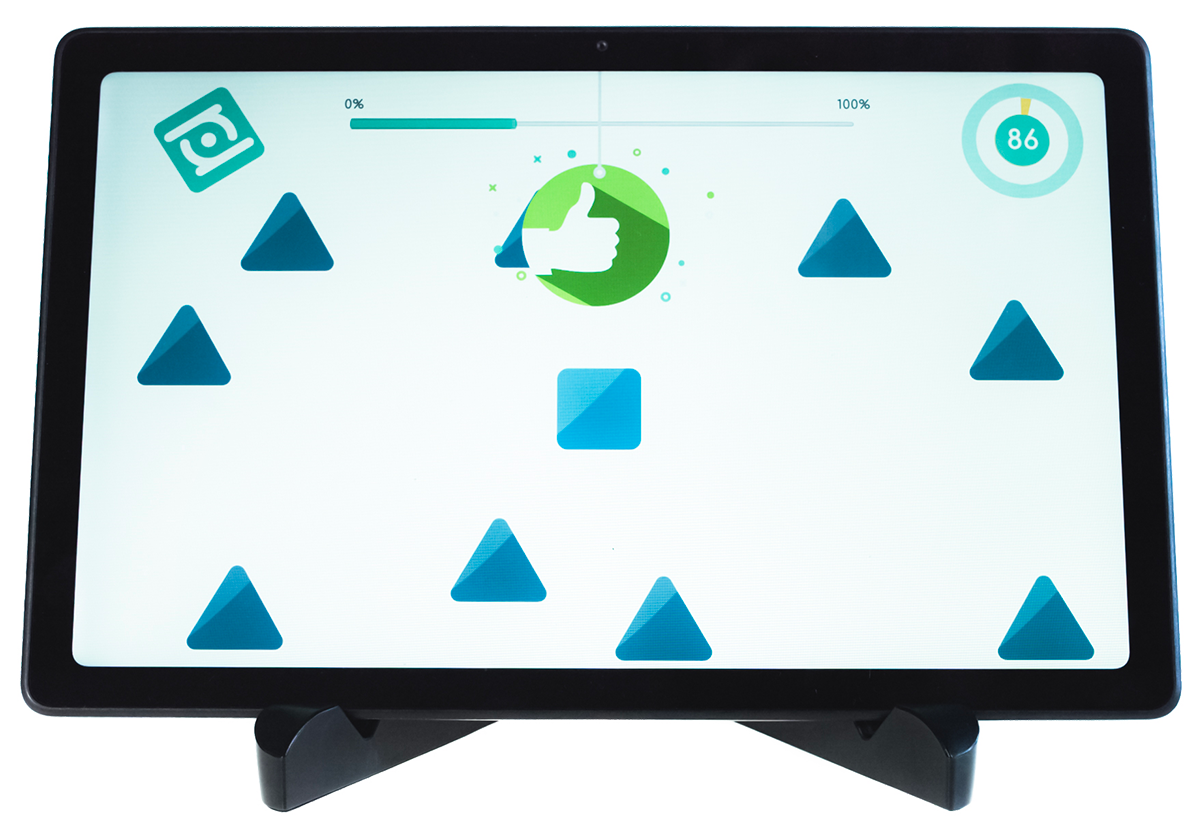
Behind every serious game in MindLenses Professional lies more than just a cognitive training-type of exercise — there’s intelligent technology designed to actively train the brain.
Our games target key cognitive functions like attention, language, memory, and reasoning, while automatically adapting difficulty based on each patient’s level. They are delivered within the optimal window of increased brain excitability opened by non-invasive neuromodulation through prismatic adaptation.

Dynamic: The game adapts to the person, not the other way around
Targeted: Each exercise trains a functional area across different conditions
Measurable: Download detailed reports to track your patient’s progress, session by session.
Fast. Focused. Effective in Just 10 sessions
Thanks to its innovative approach and a structured protocol of just 10 sessions, MindLenses helps patients achieve superior results compared to traditional rehabilitation methods, which are typically based on paper-and-pencil exercises or standard cognitive training that doesn’t have the added “boost” of neuromodulation.
These results have been validated by numerous clinical studies across a variety of patient populations.

A New Frontier In Stroke Rehabilitation
STABLE RESULTS UP TO 6 MONTHS, DEMONSTRATED BY FOLLOW-UP STUDIES
MindLenses was born from expertise in techniques for visuospatial deficits following stroke.
Today, that knowledge has expanded to include more complex cognitive functions such as memory and language, making MindLenses suitable for addressing various types of cognitive disorders that can arise after an acquired brain injury, such as an ischemic or hemorrhagic stroke.
From post-acute care to outpatient settings, MindLenses is suitable for use with post-stroke patients experiencing disorders of:

Memory
Language
Attention
Praxia
Executive Function
CERTIFIED CLASS IIA MEDICAL DEVICE FOR POST-STROKE
Real Experiences,
Real Results
Download the clinical case study developed in collaboration with IRCCS Fondazione Santa Lucia in Rome and discover how MindLenses helped improve visuospatial memory, visual search, and attention in a post-stroke patient—in just 10 sessions.
CURRENTLY AVAILABLE IN 7 LANGUAGES:
ENGLISH, FRENCH, GERMAN, DANISH, SWEDISH, DUTCH


When Neuroscience Meets Play, ADHD Intervention Gets Smarter
MindLenses therapy works on the brain’s “control center” — the areas that, in people with ADHD, can make certain everyday tasks more difficult. This includes, for example: planning the day without forgetting appointments, organizing work and finishing tasks without getting lost in the details or procrastinating, meeting deadlines without a last-minute rush, controlling impulses and automatic behaviors that may challenge social interactions, and staying focused on a task.
By combining neuromodulation with prismatic adaptation and serious games, MindLenses stimulates the executive control and cortico-cerebellar networks in the brain — areas that research has shown to be underactive in ADHD and linked to its symptoms.
As a result, a course of treatment (10 sessions) effectively trains cognitive skills, with a particular focus on executive functioning, often leading to concrete improvements in daily life, work, and school performance.
Integrating MindLenses into ADHD Treatment: How Does It Work?
Integrating MindLenses into ADHD Treatment: How Does It Work?
In recent years, the range of treatments aimed at easing ADHD symptoms and reducing functional impairment has grown considerably.
Some non-pharmacological approaches — such as behavioral therapy, cognitive training, psycho-educational interventions, or neurofeedback — have shown benefits in areas like parent–child relationships or addressing certain psychological indicators such as anxiety levels. However, few of these methods are backed by strong clinical evidence of effectiveness.
MindLenses, by contrast, is grounded in solid scientific research. It can be used alongside behavioral and pharmacological therapy, with the goal of strengthening executive functions and self-regulation.
ADHD: How MindLenses Makes a Difference
Discover the journey of Giacomo, a child with ADHD who, thanks to MindLenses, learned new strategies to focus, get organized, and thrive both at school and during his free time. Written in collaboration with the clinical team at the Child Neuropsychiatry Department of Policlinico Umberto I in Rome.

CERTIFIED MEDICAL DEVICE FOR ADHD INTERVENTION ONLY AVAILABLE IN ITALY
Safe, Innovative, Clinically Validated
Read What Patients and Doctors Say About MindLenses
Professionals

Parents tell us their children are more focused, better organized, and achieving improved results at school — often after just a few sessions.
Dr. Lauro Quadrana, Responsible of the Psychodiagnostics Clinic for Child and Adolescent Neurodevelopmental Disorders, Neuropsychiatry Unit, Policlinico Umberto I° (Roma), “La Sapienza” University

The most rewarding moment? When families leave my office smiling and immediately book the next cycle. That’s when I know MindLenses is truly making a difference.
Dr. Riccardo Corsi, psychologist – Centro Implicita, Verona

At our center, we believe that technology — when guided by listening, empathy, and professionalism — can truly change people’s lives. That’s why we chose to adopt MindLenses Professional.
Ilenia Falcone, Psychologist specialized in Specific Learning Disorders and Clinical Psychodiagnostics at Il Cerchio della Vita APS (Foggia)

I personally tried MindLenses and noticed an improvement in attentional focus. At the Italian ADHD Center, we have integrated the tool into our Milan facility as part of our non-pharmacological therapeutic programs.
Dr. Elena Vlacos, Neuropsychologist, Founder and CEO of the Italian Center for ADHD

What I appreciate about MindLenses is its ability to stimulate the brain using a simple, non-invasive, and well-tolerated tool. It’s rare to find an approach that’s both so effective and so respectful of the patient.
Dr. Lucia Ferroni, Physiatrist – ASL Toscana Nord-Ovest
Patients
During the MindLenses program, my son was more present, clear-headed, and engaged. Even friends who came to visit noticed the difference.
Marco, father of Alessio, a brain injury patient treated by Dr. Ferroni
Since Valentina completed her MindLenses treatment, the atmosphere at home has been much calmer. She’s less stressed, and everything feels lighter for us as parents too.
Giulia and Paolo, parents of Valentina, age 11 – ADHD diagnosis, treated by Dr. Quadrana
We’re thrilled. Since Lorenzo started with MindLenses, he’s more focused and connected. The other day, he remembered the way to the clinic on his own — that had never happened before.
Daniele, father of Lorenzo, a child with ADHD treated by Dr. Corsi
1.
Assess the patient at intake with MindLenses’ neuropsychological tests
2.
Execute the 10 rehab protocol, with prismatic adaptation and serious games
3.
Reassess at the end of the protocol and download a clear, ready-to-share clinical report
Please note: MindLenses is not a diagnostic device.
MindLenses Neuropsychological Testing and Reporting
MindLenses includes a suite of neuropsychological tests inspired by the tools most widely used in clinical practice*.
Patients are assessed before and after the rehabilitation program, with tests covering a wide range of cognitive functions:
- General Cognition
- Cognitive Level
- Attention
- Memory
- Language
- Executive Functions
- Praxis
*Warning: MindLenses is not a diagnostic device. The tests included are intended solely to support the therapy, providing general indications on the progress of the cognitive functions being treated, and do not replace a comprehensive clinical evaluation by a specialist.
Cognitive rehabilitation suitable for public and private healthcare facilities, usable in wards, clinics, offices, or at home.
MindLenses is designed for use by medical professionals (e.g. medical doctors, neuropsychologists, rehabilitation specialists, and speech-language therapists) in both hospital and outpatient settings.
Frequently Asked Questions – For Medical Professionals
What does it mean that MindLenses is a certified medical device?
Certification as a Medical Device ensures that MindLenses has undergone a rigorous evaluation and testing process designed to protect people’s safety and health. This process includes verifying the device’s safety, assessing clinical effectiveness through rigorous clinical studies, and conducting risk analyses to ensure that the benefits clearly outweigh any potential contraindications. Being certified is not just a regulatory requirement — it is a mark of quality, transparency, and reliability. It means that what we promise is backed by real data, and that you can use MindLenses with the confidence of a tool validated according to the highest standards in Europe and worldwide.
Can I buy MindLenses directly?
Yes, but only if you are a licensed healthcare professional: only doctors, psychologists, and other qualified medical professionals can purchase MindLenses Professional directly. If you’re a patient – or a family member looking for support for a loved one – you can contact a professional who already uses MindLenses, either through the public healthcare system or via private clinics. Find a MindLenses provider near you!
How much does MindLenses cost?
How long does a MindLenses treatment last?
The treatment consists of 10 sessions, to be completed over 2 weeks (no more than one session per day).
How often can the treatment be repeated?
Every six months.
How long do the effects of prismatic adaptation last?
Within the rehabilitation session: The window of increased brain plasticity lasts for about 90 minutes after the prism adaptation stimulus – enough to cover a full cognitive training session with selected serious games.
Long term (after a 10-sessions therapy cycle): Studies have shown that, after a complete treatment cycle, clinical benefits are maintained for up to 6 months.
Up to what level of cognitive impairment can MindLenses be used?
The therapy is designed to be accessible to people with mild to moderate cognitive impairment. It is always the healthcare professional who assesses the patient’s eligibility for the therapy.
I use neurofeedback in my clinical practice. How is MindLenses different?
Neurofeedback uses electroencephalographic (EEG) signals to train the brain to regulate its own activity through a real-time feedback system. It is, therefore, a method of recording brain activity, which is then used for clinical purposes. MindLenses’ prismatic adaptation, on the other hand, is a neuromodulation technique, meaning it acts directly on the brain — although non-invasively and without the use of direct or external instrumentation on the patient — by temporarily modulating brain activity. This modulation is excitatory in nature: neurons in certain brain areas become temporarily more “active” after undergoing prismatic adaptation. In short: neurofeedback measures and trains; MindLenses stimulates and primes.
How does prism adaptation differ from other neuromodulation techniques, such as transcranial electrical stimulation (tES) or transcranial magnetic stimulation (TMS)?
Similarities: all three can modulate brain activity, either excitatory — temporarily increasing neuronal activation — or inhibitory, temporarily reducing it. They therefore all fall under neuromodulation techniques. The main difference lies in how they achieve these effects. tES and TMS rely on external devices: tES uses low-intensity electrical current, while TMS uses magnetic fields to stimulate specific brain areas. Prismatic adaptation, instead, does not employ electrical or magnetic devices but leverages the patient’s visual and perceptual system. Using special prismatic lenses, it induces a recalibration of visuomotor perception and coordination mechanisms, which in turn stimulates and modulates the involved neural networks. In summary: tES and TMS are exogenous neuromodulation techniques (the modulation is induced by external devices), while prism adaptation is an endogenous technique, where the brain itself readjusts and reorganizes in response to a targeted sensory change.